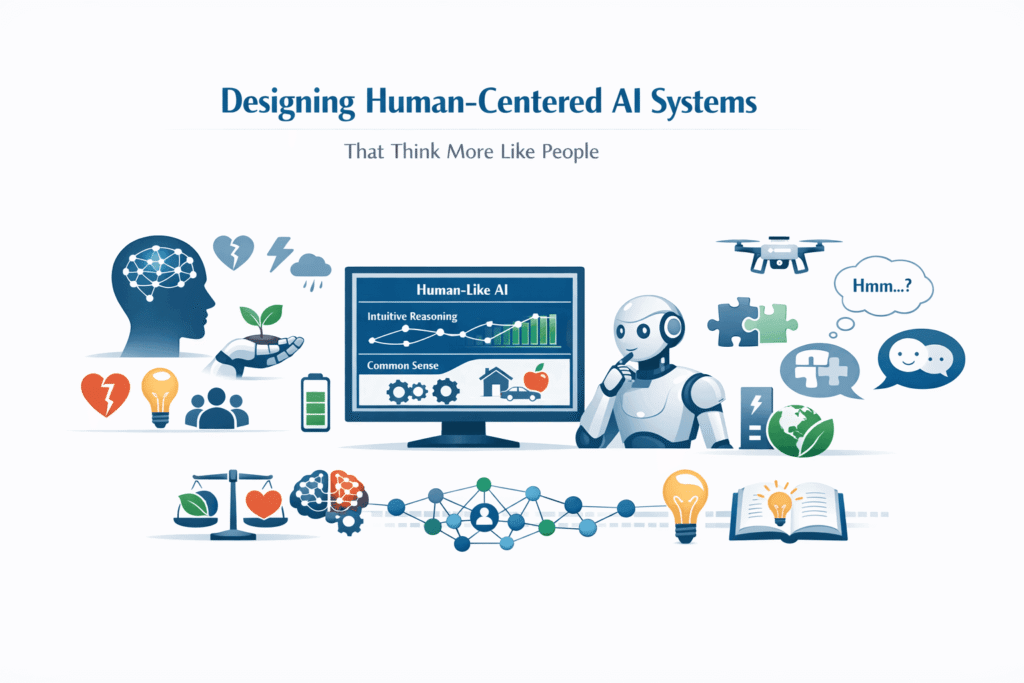
Executive Summary
This research investigates how artificial intelligence can be designed to reason, learn, and interact in ways that align with human cognitive and ethical expectations. The work responds to the rapid expansion of machine‑learning systems into everyday life—where AI increasingly influences decisions, behaviours, and social structures. As noted in the source document, “Human‑Centered AI aims to create AI systems that amplify and augment human capabilities and maintain human control” .
The study adopts an interdisciplinary approach spanning cognitive science, machine learning, human–computer interaction, and explainable AI. Its goal is to build frameworks that support transparent, trustworthy, and socially aligned AI systems capable of operating responsibly in mixed human–machine environments.
Focus and Approach
Core Research Domains
Human‑Centred AI and ethical alignment
Human–machine interaction and cognitive modelling
Explainable AI and reasoning frameworks
Human‑Centred Machine Learning evaluation practices
Methodological Philosophy A mixed‑methods research design combining conceptual modelling, qualitative inquiry, and quantitative experimentation. The approach emphasises iterative validation, stakeholder involvement, and the integration of human reasoning patterns into AI system design.
Key Findings (Interim)
Modern ML models excel at pattern recognition but lack causal reasoning and intuitive understanding—echoing the document’s observation that “truly human‑like learning… requires advancements in causal models” .
Human reasoning models such as hypothetico‑deductive thinking offer a foundation for more interpretable and trustworthy AI behaviour.
AI systems require clearer transparency mechanisms, bias‑mitigation strategies, and user‑centred explanation models to support safe deployment in sensitive domains.
Human emotions, cultural norms, and cognitive biases significantly influence how people interpret AI decisions—highlighting the need for emotionally aware and context‑sensitive system design.
Developers lack unified testing platforms that support multimodal evaluation, limiting the ability to validate AI behaviour across diverse real‑world contexts.
Policy Recommendations (Preliminary)
Define standards for transparency, accountability, and user‑aligned system behaviour across sectors.
Invest in testing platforms that support cross‑modal model assessment, bias detection, and explainability benchmarking.
Encourage the adoption of causal modelling, compositional learning, and intuitive physics/psychology frameworks in AI development.
Ensure diverse stakeholder involvement to surface cultural, emotional, and ethical considerations early in the design process.
1. Introduction
AI systems increasingly shape decisions in healthcare, finance, mobility, and public services. Yet most models remain optimised for statistical accuracy rather than human‑aligned reasoning. This creates gaps in trust, transparency, and social compatibility. As the document highlights, “AI systems can significantly affect human lives and play an active role in society” .
This research addresses the need for AI systems that not only perform well but also behave in ways that are interpretable, ethically grounded, and aligned with human expectations.
1.1 Context for This Work
Growing societal reliance on machine‑learning systems
Increasing ethical concerns around privacy, bias, and autonomy
Expanding use of AI in emotionally and socially sensitive environments
Lack of unified evaluation methodologies for human‑centred ML
Rising demand for explainability in high‑stakes decision‑making
1.2 Report Structure
Overview of the research problem and context
Description of the methodological framework
Summary of qualitative and quantitative approaches
Interim insights and implications
Policy and design recommendations
2. Approach to the Study
The research follows a multi‑stage plan integrating literature synthesis, conceptual framework development, experimental modelling, and multimodal evaluation. Early phases focus on mapping human reasoning processes and translating them into explainable AI structures. Later phases test these frameworks using black‑box models and visual sentiment analysis techniques.
2.1 Approach to Qualitative Research
Methods Used
Expert interviews with HCI and AI practitioners
Stakeholder analysis from human‑computer interaction datasets
Thematic analysis of ethical and cognitive‑science literature
Conceptual modelling of human reasoning patterns
Purpose of Each Method
Interviews: Surface practical challenges and expectations in real‑world AI deployment
Stakeholder analysis: Understand user needs, emotional responses, and trust dynamics
Thematic analysis: Identify recurring ethical, social, and cognitive considerations
Conceptual modelling: Translate human reasoning into structured AI design principles
2.2 Approach to Quantitative Analysis and Key Findings
Methods Used
Benchmarking ML models using explainability toolkits (e.g., Alibi)
Multimodal model testing across image, text, and behavioural datasets
Visual sentiment analysis to correlate image features with emotional responses
Performance comparison across model architectures and modalities
Early Measurable Insights
Explainability methods vary widely in clarity and user interpretability
Visual sentiment models show strong correlations between low‑level image features and emotional classification
Multimodal testing reveals inconsistencies in model behaviour across contexts
Pre‑trained language–vision models demonstrate promising generalisation for semantic search tasks