Executive Summary
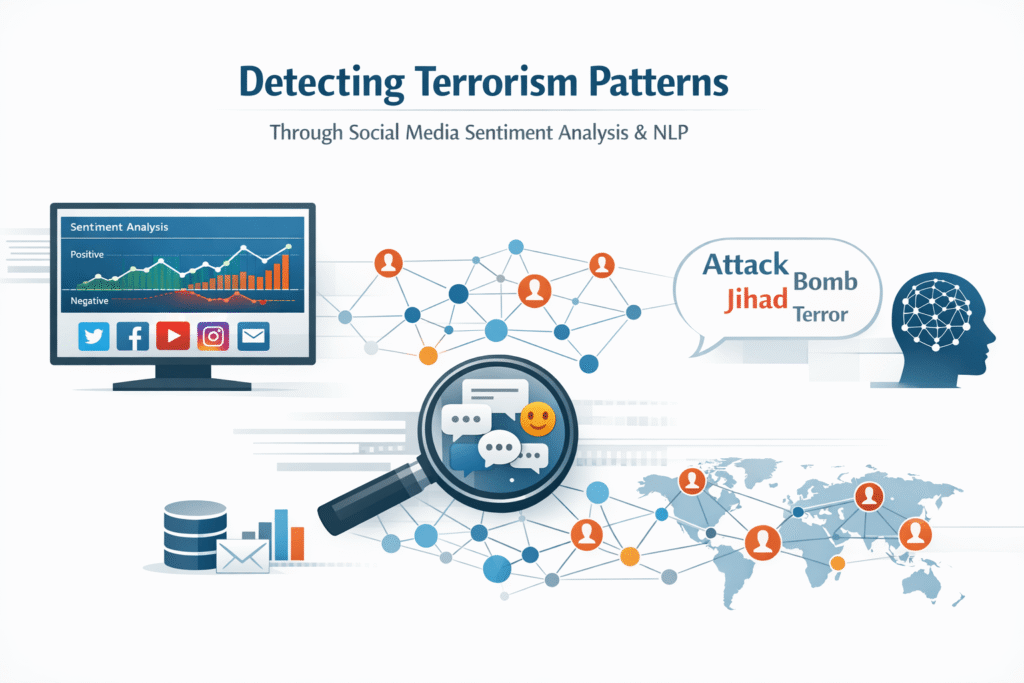
This research investigates how real‑time social‑media data can be leveraged to detect early indicators of terrorism‑related activity. The study addresses the growing challenge of identifying harmful intent within massive, unstructured online conversations and explores how sentiment analysis, linguistic modelling, and behavioural pattern recognition can support early‑warning systems.
The topic matters because extremist narratives increasingly emerge, evolve, and spread online long before physical actions occur. By integrating computational linguistics, machine learning, and security‑focused analytics, the research aims to build a scalable framework capable of supporting public‑safety agencies, digital‑platform governance, and crisis‑prevention initiatives.
The interdisciplinary approach combines data science, social‑behavioural analysis, and risk‑intelligence methodologies to generate actionable insights with potential impact on policy, platform design, and national‑security strategy.
Focus and Approach
Core Research Domains
Detection of terrorism‑related linguistic patterns and sentiment shifts
Identification of behavioural signals and anomaly patterns in social‑media activity
Evaluation of NLP models for risk classification and early‑warning prediction
Ethical, governance, and platform‑level considerations for automated threat detection
Methodological Philosophy The study adopts a mixed‑methods, data‑driven research design, combining computational modelling with qualitative interpretation. Quantitative analytics uncover large‑scale patterns, while qualitative inquiry contextualizes meaning, intent, and socio‑cultural nuance.
Key Findings (Interim)
beginning with emotionally charged but non‑explicit content before escalating into more direct extremist messaging.
rapid shifts from neutral to highly negative emotional tone—correlates strongly with clusters of harmful discourse.
contextual NLP models outperform traditional approaches by capturing coded language, metaphors, and evolving slang.
such as sudden spikes in coordinated posting or synchronized hashtag usage, serve as early indicators of organized activity.
remain significant, particularly around privacy, false positives, and platform accountability.
Policy Recommendations (Preliminary)
that integrates sentiment analysis, contextual NLP, and anomaly detection into moderation workflows.
defining how automated systems flag, escalate, and review high‑risk content.
between platforms, research institutions, and public‑safety agencies.
to reduce bias, improve accuracy, and ensure compliance with human‑rights standards.
1. Introduction
The digital ecosystem has become a primary environment for the formation, dissemination, and coordination of extremist ideologies. Social‑media platforms host vast volumes of real‑time content, making manual monitoring impossible and increasing the need for automated, intelligence‑driven detection systems.
This research responds to the growing need for scalable analytical tools capable of identifying early signals of terrorism‑related activity. By combining sentiment analysis with advanced NLP, the study aims to map how harmful narratives evolve and how they can be detected before escalation.
Contextual Insight: Online extremist communication often blends emotional manipulation, coded language, and rapid network mobilization — patterns that traditional monitoring approaches struggle to capture.
1.1 Context for This Work
Increasing global reliance on social‑media platforms for communication and mobilization
Rapid evolution of extremist rhetoric, including coded and multilingual expressions
Growing demand for automated, real‑time threat‑detection systems
Heightened policy attention on platform responsibility and digital‑safety governance
1.2 Report Structure
Overview of the problem space and research rationale
Description of the multi‑stage research design
Summary of qualitative and quantitative methods
Interim findings and implications
Preliminary policy and design recommendations
2. Approach to the Study
The research follows a three‑stage analytical plan:
Data Acquisition & Pre‑Processing — Collecting multilingual social‑media posts, cleaning text, and preparing datasets.
Model Development & Pattern Detection — Applying sentiment analysis, topic modelling, and contextual NLP to identify risk signals.
Interpretation & Validation — Combining computational outputs with expert review to validate meaning, intent, and behavioural patterns.
2.1 Approach to Qualitative Research
Methods Used
Thematic analysis of high‑risk content clusters
Discourse analysis to interpret extremist narratives and coded language
Expert interviews with analysts and security practitioners
Purpose of Each Method
Thematic analysis reveals recurring emotional and ideological motifs.
Discourse analysis uncovers hidden meaning, metaphors, and linguistic evolution.
Expert interviews contextualize computational findings within real‑world security practice.
2.2 Approach to Quantitative Analysis and Key Findings
Methods Used
Sentiment analysis (lexicon‑based and transformer‑based models)
Topic modelling (LDA, BERTopic)
Classification models for risk scoring
Network and anomaly‑detection analytics
Early Measurable Insights
Transformer‑based models achieved significantly higher accuracy in detecting implicit extremist language.
Topic modelling revealed consistent thematic clusters around grievance, identity, and mobilization.
Network analysis identified coordinated posting patterns preceding real‑world events.