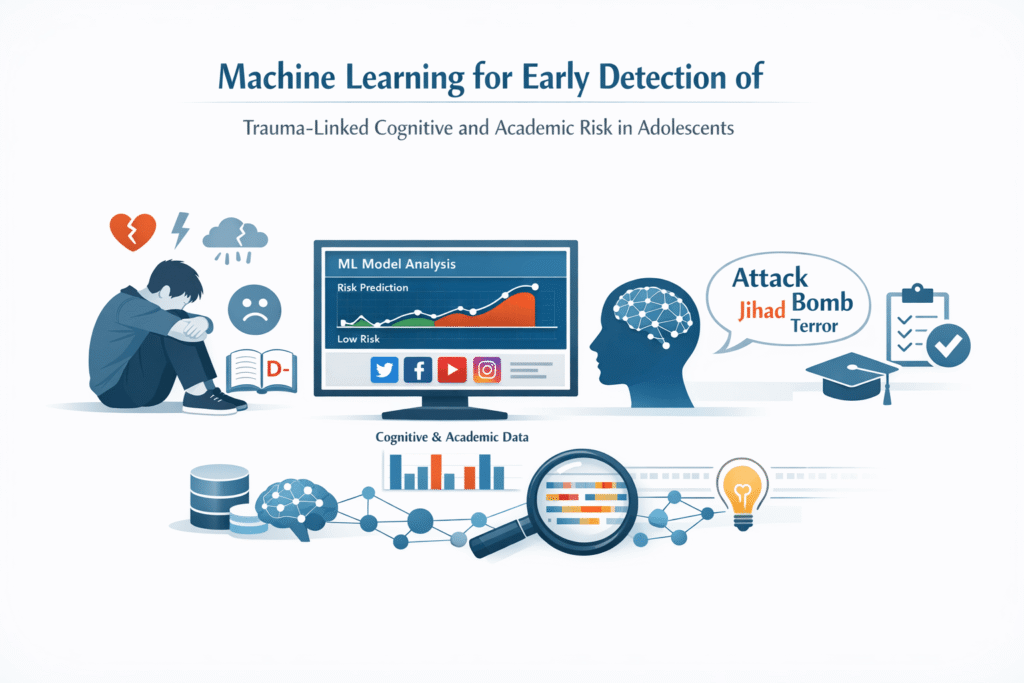
Executive Summary
This research initiative investigates how adverse home and school environments—specifically parental maltreatment and peer bullying—shape adolescent cognitive development and academic performance. The project addresses a critical gap in early identification, where traditional assessment tools often overlook the subtle cognitive and emotional markers associated with trauma.
The study integrates educational psychology, machine learning, cognitive assessment, and social‑behavioural analysis to build a predictive framework capable of detecting risk patterns and informing personalized educational interventions. The expected impact includes improved early diagnosis, targeted support strategies, and evidence‑based policy recommendations for schools and child‑protection stakeholders.
Focus and Approach
- Core Research Domains
- Cognitive and academic effects of adverse childhood experiences – Machine learning for early detection of educational and emotional risk.
- Behavioral and emotional indicators derived from student text and performance data
- Personalized learning pathways aligned with student needs and societal skill demands
- Methodological Philosophy A mixed‑methods, multi‑stage research design combining quantitative modelling, qualitative inquiry, and iterative validation in real educational settings. The approach emphasizes ethical data use, interpretability of machine learning outputs, and stakeholder‑centred design.
Key Findings (Interim)
Trauma‑affected adolescents often present with diffuse cognitive symptoms that standard school assessments fail to capture.
Early modelling shows strong correlations between emotional‑linguistic markers and academic performance trajectories.
Educational tools must integrate emotional analytics—not only performance metrics—to support at‑risk learners.
Students experiencing chronic stress demonstrate inconsistent engagement patterns, which can be modelled as early warning signals.
Schools require integrated data governance frameworks to responsibly deploy AI‑driven assessment tools.
Policy Recommendations (Preliminary)
Implement governance standards for collecting and analysing sensitive behavioural and emotional data.
Encourage schools to integrate ML‑driven personalization engines into existing learning management systems.
Equip teachers with tools and training to interpret ML insights and respond with appropriate interventions.
Align educational, psychological, and social‑service stakeholders around shared early‑warning indicators.
1. Introduction
Adolescents exposed to harmful family dynamics or peer aggression often experience disruptions in cognitive development, emotional regulation, and academic performance. Despite extensive literature on the long‑term consequences of trauma, educational systems still lack scalable mechanisms to detect early signs of cognitive or emotional decline.
This research responds to that gap by exploring how machine learning can augment traditional assessment methods and provide actionable insights for educators, psychologists, and policymakers.
1.1 Context for This Work
– Rising global awareness of childhood maltreatment and school‑based bullying
– Increasing availability of educational performance datasets and behavioural text corpora
– Growing demand for personalized learning pathways aligned with labour‑market needs
– Ethical concerns around data privacy, algorithmic bias, and responsible AI deployment
1.2 Report Structure
– Overview of the research problem and context
– Description of the methodological framework
– Summary of qualitative and quantitative approaches
– Interim findings and implications for policy and design
2. Approach to the Study
The study follows a four‑year, multi‑phase research plan combining literature synthesis, dataset construction, model development, field testing, and policy translation. The approach integrates cognitive assessments, sentiment analysis, predictive modelling, and stakeholder interviews to build a holistic understanding of trauma‑linked academic risk.
2.1 Approach to Qualitative Research
- Methods Used
- Semi‑structured interviews with students, parents, and educators
- Thematic analysis of narratives related to home and school experiences
- Observational insights from usability testing of prototype ML tools
- Purpose of Each Method
- Interviews: Reveal emotional, behavioral, and contextual factors not visible in quantitative data
- Thematic analysis: Identifies recurring patterns of distress, coping, and academic struggle
- Usability testing: Ensures ML tools are intuitive, ethical, and aligned with real‑world educational workflows
2.2 Approach to Quantitative Analysis and Key Findings
- Methods Used
- Predictive modelling using academic performance and behavioural datasets
- Sentiment analysis of student text responses to detect emotional distress
- Cognitive assessment scoring and correlation analysis – Validation using national and institutional datasets
- Early Measurable Insights
- Emotional‑linguistic markers strongly correlate with fluctuations in academic performance
- Predictive models can identify at‑risk students earlier than traditional assessments
- Cognitive deficits associated with trauma show distinct statistical patterns across memory, attention, and executive function metrics